


This case clearly illustrates just how unexpected the circumstances of anti-doping cases can be. Sometimes, identifying the source of a prohibited substance requires examining not only medical records but even the football pitch itself.
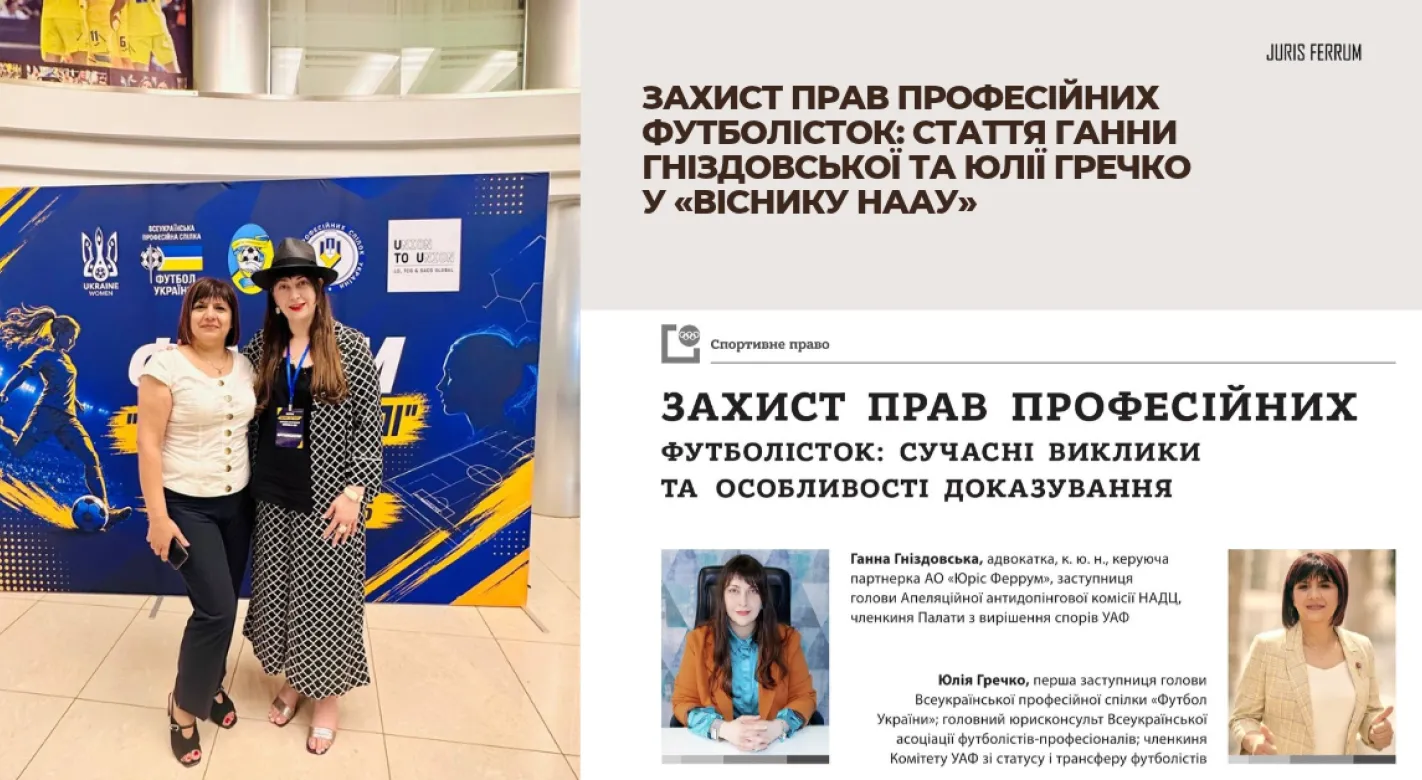
Anti-doping proceedings, contractual disputes, and the protection of women footballers’ rights during pregnancy and maternity are examined in the article “Protecting the Rights of Professional Women Footballers: Current Challenges and Evidentiary Issues”, published in the September issue of the UNBA Bulletin, No. 9 (124), 2026.
Authors:
- Ganna Gnizdovska — attorney, PhD in Law, Managing Partner of Juris Ferrum Law Firm, Deputy Chair of the NADC Anti-Doping Appeals Commission, and member of the UAF Dispute Resolution Chamber.
- Yuliia Hrechko — First Deputy Chair of the All-Ukrainian Trade Union “Football of Ukraine”, Chief Legal Counsel of the All-Ukrainian Association of Professional Footballers, and member of the UAF Committee on the Status and Transfer of Football Players.
What Does the Article Cover?
Professional women’s football continues to develop, but new opportunities also bring legal challenges. Unpaid salaries, anti-doping rule violations, and maternity protections can all have a direct impact on a footballer’s career and financial position.
We examine three areas of protecting athletes’ rights through real cases from Ukrainian and international practice.
Anti-Doping Disputes: Why Does an Analytical Result Not Tell the Whole Story?
The presence of a prohibited substance in an athlete’s sample does not, in itself, determine the degree of the athlete’s fault or the potential consequences of the anti-doping rule violation.
In the Chioma Ubogagu case, the source of the prohibited substance was medication prescribed by a dermatologist. The violation was found to be unintentional and the athlete was found to bear No Significant Fault or Negligence. However, she did not establish No Fault or Negligence, in particular because she had failed to independently check the anti-doping status of the medication. As a result, the footballer received a nine-month period of ineligibility.
The case involving a Norwegian footballer from Vålerenga developed differently. Following a match on 22 April 2025, traces of the prohibited stimulant DMBA were detected in samples from eight athletes, although only one sample contained a concentration above the minimum reporting level.
Anti-Doping Norway’s investigation linked the presence of the substance in the athlete’s body to rubber granulate used on the artificial football pitch. The competent body found No Fault or Negligence, and therefore no period of ineligibility was imposed.
The absence of intent does not automatically mean the absence of fault. In anti-doping cases, medical records, expert evidence, and evidence establishing the source of the prohibited substance can be decisive.
Contractual Disputes: What Can Players Do If a Club Fails to Pay Their Salary?
In 2021, seven players from the women’s football club “Bukovynska Nadiia” brought claims before the UAF Dispute Resolution Chamber over the club’s failure to fulfil its contractual obligations.
The Chamber upheld their claims, awarding outstanding payments ranging from UAH 24,000 to UAH 68,000, while one of the athletes was also awarded compensation for medical treatment and rehabilitation expenses. However, the club failed to comply with the decisions voluntarily.
In October 2022, three of the footballers received USD 10,366 in financial assistance through the FIFA Fund for Football Players — a special mechanism designed to support footballers who, under certain conditions, are unable to recover payments owed to them by their clubs.
This did not constitute compulsory enforcement of the Chamber’s decisions, but rather a separate form of financial assistance. The case serves as a reminder that winning a dispute does not necessarily mean actually recovering the money awarded. That is why, when protecting athletes’ rights in disputes with clubs, the prospects for enforcement should be assessed in advance.
Maternity and Professional Football: What Protections Do Women Footballers Have?
Can a club stop paying a footballer’s remuneration because she is pregnant? This was the issue at the heart of the case of Sara Björk Gunnarsdóttir v. Olympique Lyonnais.
After notifying the club of her pregnancy, the player did not receive her contractual remuneration in full. The club argued that she was not training or participating in matches.
A separate dispute arose over FIFA’s jurisdiction. Olympique Lyonnais relied on the provisions of the contract and French employment law, contesting the jurisdiction of the FIFA body to hear the case.
Following the proceedings, the club was ordered to pay the footballer EUR 82,094.82 in outstanding remuneration plus 5% interest per annum.
The case became an example of how specific maternity protections in professional football operate in practice. Importantly, the outcome depended not only on FIFA regulations but also on medical records, notice of pregnancy, correspondence between the parties, and the circumstances surrounding performance of the contract.
Why Is Evidence So Important?
Anti-doping proceedings, contractual disputes, and maternity protection cases are governed by different rules. However, in each of the cases examined, the outcome depended on establishing the relevant facts and supporting them with appropriate evidence.
In one case, it was necessary to establish the source of the prohibited substance; in another, to prove the club’s outstanding debt; and in the third, to establish a breach of contractual protections and determine the competent body to hear the dispute.
Legal assistance for athletes therefore begins with an analysis of the documents, applicable regulations, procedural time limits, and available remedies. Sometimes, evidence gathered at the right time can determine the entire course of a case.
For the team at Juris Ferrum Law Firm, sports law is first and foremost about protecting the people who have dedicated themselves to sport. Behind every dispute are not only regulatory provisions, but also an athlete’s career, income, and professional future.
We thank the editorial team of the UNBA Bulletin for publishing our article!
The full text of the article “Protecting the Rights of Professional Women Footballers: Current Challenges and Evidentiary Issues” was published in the UNBA Bulletin, No. 9 (124), September 2026, pp. 32–38.