



- Anti-Doping Rule Violations: Why the Absence of Intent Does Not Always Exclude Liability
- Contractual Disputes: Why a Decision in a Footballer’s Favour Does Not Guarantee Recovery of the Money
- Protecting Women Footballers’ Rights During Pregnancy and Maternity
- Why Is Evidence Crucial to Protecting Women Footballers’ Rights?
Anti-Doping Rule Violations: Why the Absence of Intent Does Not Always Exclude Liability
Anti-doping regulation is based, among other things, on the principle that athletes are personally responsible for the presence of a prohibited substance, its metabolites, or markers in their samples. Therefore, even the absence of intent to use a prohibited substance does not always allow an athlete to avoid a period of ineligibility.
The case of professional footballer Chioma Ubogagu, who played for Tottenham Hotspur Women, provides a notable example.
In 2021, an out-of-competition test revealed canrenone in her sample — a metabolite of spironolactone, which falls within class S5, “Diuretics and Masking Agents,” of the WADA Prohibited List.
The medication had been prescribed by a dermatologist to treat acne. The footballer had not used it to enhance her sporting performance and had assumed that the doctor, who was aware of her status as a professional athlete, would not prescribe a prohibited substance.
During the proceedings, it was established that the violation was not intentional. At the same time, the athlete had not independently checked the status of the medication before using it.
As a result, the Independent Regulatory Commission of the Football Association found that the footballer bore No Significant Fault or Negligence and imposed a nine-month period of ineligibility. No Fault or Negligence was not established.
A proceeding that arose in Norway in 2025 had a fundamentally different outcome.
Following a match between the women’s teams LSK Kvinner and Vålerenga, traces of the prohibited stimulant DMBA were detected in samples from eight footballers. In one athlete’s sample, the concentration exceeded WADA’s minimum reporting level, and the laboratory therefore reported an adverse analytical finding.
The subsequent investigation led to an unexpected conclusion: the source of the prohibited substance was the rubber granulate used on the artificial football pitch, which had been manufactured from recycled vehicle tyres.
Repeat testing of the same footballers following matches at other stadiums did not detect DMBA. Analysis of the pitch surface established a link between the presence of the substance in the samples and the material used on the football pitch.
The competent independent body found that the footballer bore No Fault or Negligence. No period of ineligibility was imposed.
These two cases demonstrate why a laboratory result cannot be assessed in isolation from the surrounding circumstances. It is important to establish the source of the prohibited substance, how it entered the athlete’s body, the athlete’s conduct, and the degree of fault.
Sometimes this requires an examination of medical records, the history of medication use, and explanations provided by doctors. At other times, it may even require an examination of the material used on the football pitch.
This is precisely why legal protection of athletes’ rights in anti-doping disputes requires a thorough analysis of all relevant factual circumstances and the careful development of the evidentiary record.
Contractual Disputes: Why a Decision in a Footballer’s Favour Does Not Guarantee Recovery of the Money
In professional football, obtaining a decision awarding outstanding payments and actually recovering the money owed are not always the same thing.
This was precisely the problem faced by seven footballers from the Ukrainian club “Bukovynska Nadiia”.
In 2021, the players sought legal protection after the club failed to fulfil its contractual obligations, primarily its obligation to pay their salaries.
After their attempts to resolve the matter directly with the club proved unsuccessful, the footballers filed claims with the UAF Dispute Resolution Chamber.
On 11 August 2021, the Chamber upheld their claims. The amounts awarded ranged from UAH 24,000 to UAH 68,000, while in the case of Yuliia Korniievets, an additional UAH 68,829.99 in medical treatment and rehabilitation expenses was awarded.
At first glance, the footballers’ rights had been protected.
However, the club failed to comply with the decisions voluntarily and subsequently withdrew from the 2021/2022 season competitions.
In these circumstances, the players turned to an international financial support mechanism — the FIFA Fund for Football Players (FIFA FFP), established jointly by FIFA and FIFPRO in 2020.
The Fund is designed to support professional footballers who, due to a club’s financial difficulties or bankruptcy, are unable to recover salaries owed to them and have exhausted other available means of obtaining payment.
In October 2022, three footballers from the former club “Bukovynska Nadiia” received financial assistance through the Fund totalling USD 10,366.
It is important to distinguish between the two mechanisms.
Financial assistance paid through the FIFA FFP does not constitute compulsory enforcement of a decision of the UAF Dispute Resolution Chamber and does not mean that the club has fulfilled the obligation imposed on it. It is a separate form of financial support that may cover only part of the outstanding amount.
The “Bukovynska Nadiia” case demonstrates why, in contractual disputes, it is important not only to properly substantiate the outstanding amounts and obtain a decision from the competent body, but also to assess the prospects for the effective restoration of footballers’ violated rights.
Protecting Women Footballers’ Rights During Pregnancy and Maternity
Another important issue in professional women’s football is balancing a sporting career with pregnancy and maternity.
For a long time, football regulations did not adequately address situations in which a footballer was temporarily unable to train or participate in matches due to pregnancy. This created risks of loss of income, loss of a place in the team, and even the premature end of a professional career.
Today, specific maternity protections are enshrined in the FIFA Regulations on the Status and Transfer of Players and the UAF Regulations on the Status and Transfer of Football Players.
These protections concern, among other things, pregnancy and maternity leave, remuneration during the relevant period, return to professional football activity, and the preservation of contractual rights.
However, the existence of such protections does not necessarily mean that clubs always comply with them.
One of the best-known cases is Sara Björk Gunnarsdóttir v. French club Olympique Lyonnais.
In March 2021, the Icelandic footballer informed the club that she was pregnant. She subsequently stopped training and returned to Iceland.
For April and May 2021, the club did not pay her the full remuneration provided for under her contract, arguing that the footballer was not training, participating in matches, or performing any other work for the club.
Gunnarsdóttir maintained that pregnancy did not suspend or terminate her professional contract. She also indicated that she was willing to perform other safe duties, including participating in activities promoting the club and football.
However, the club did not offer her any such work.
The dispute was heard by the Dispute Resolution Chamber of the FIFA Football Tribunal.
Following the proceedings, Olympique Lyonnais was ordered to pay the footballer EUR 82,094.82 in outstanding remuneration plus 5% interest per annum until the date of effective payment.
The case confirmed that pregnancy in itself cannot constitute grounds for placing a footballer in a less favourable contractual position.
At the same time, the resolution of the dispute depended not only on the provisions of the contract and the applicable regulations, but also on evidence of the parties’ actual conduct: notification of the pregnancy, medical documentation, correspondence with the club, demands for payment of the outstanding remuneration, the athlete’s willingness to perform other duties, and the club’s response.
It was the combined weight of this evidence that made it possible to assess how the parties had actually performed their contractual obligations. This also highlights the importance of legal protection of athletes’ rights in disputes with football clubs.
Why Is Evidence Crucial to Protecting Women Footballers’ Rights?
The cases examined concern different legal relationships and involve different mechanisms for protecting footballers’ rights.
In proceedings concerning anti-doping rule violations, it is necessary to establish the source of the prohibited substance, the circumstances in which it entered the athlete’s body, and the degree of the athlete’s fault.
In contractual disputes, it is necessary to establish the club’s failure to fulfil its obligations, properly document the outstanding amounts, and make timely use of the available mechanisms for their recovery.
In disputes relating to pregnancy and maternity, it is necessary to establish the circumstances in which the club was notified, the footballer’s health condition, her willingness to perform duties that remained available to her, and the club’s actual conduct.
Despite the differences between these categories of disputes, they have one thing in common: the existence of legal protections alone does not guarantee effective protection of rights.
It is essential to gather evidence in a timely manner, correctly identify the competent body to hear the dispute, and choose the appropriate legal remedy.
After all, behind regulatory provisions, contracts, and decisions of football bodies are real people, their professional careers, and their individual circumstances. And the ability to continue a professional sporting career often depends on the effectiveness of legal protection in the field of sports.
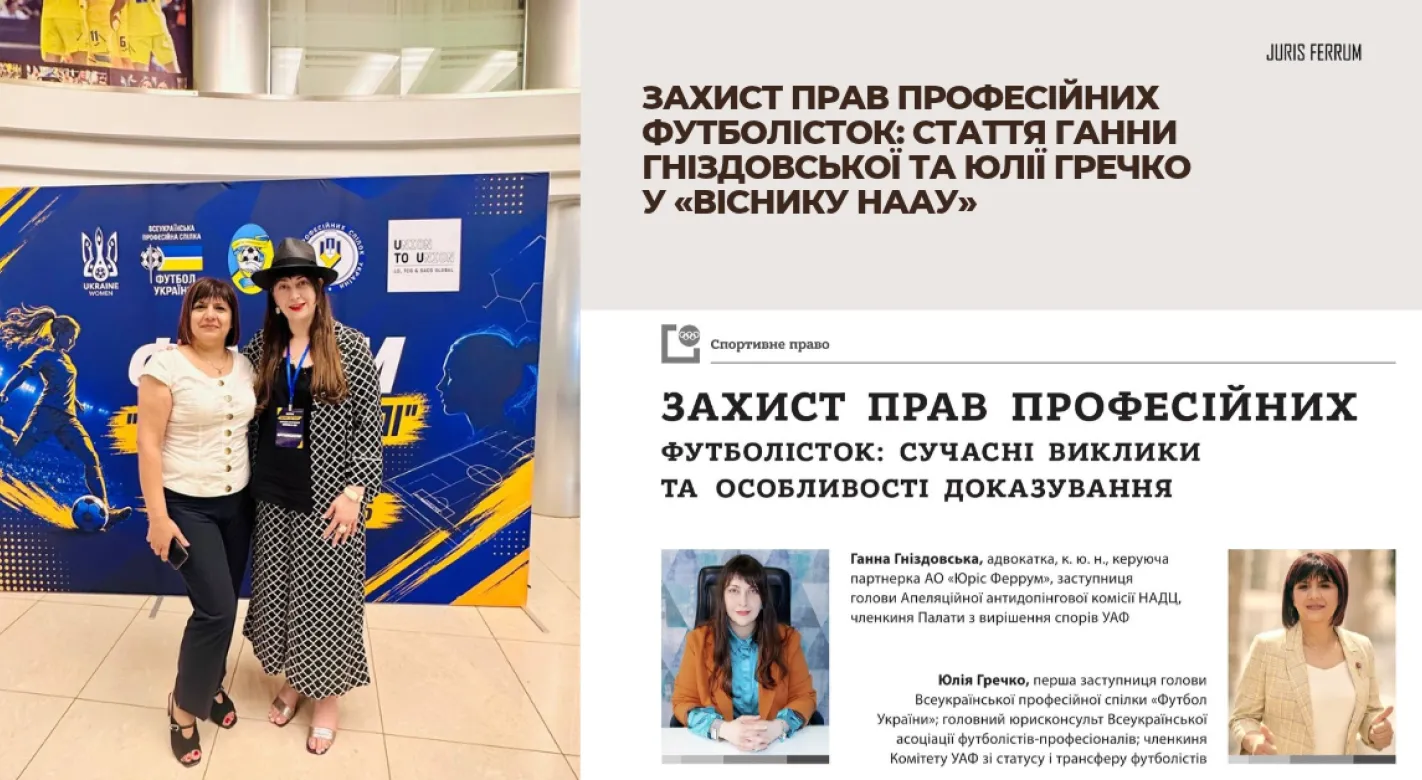
Authors: Ganna Gnizdovska, attorney, PhD in Law, Managing Partner of Juris Ferrum Law Firm, sports law specialist, Deputy Chair of the NADC Anti-Doping Appeals Commission, member of the UAF Dispute Resolution Chamber, and Yuliia Hrechko, First Deputy Chair of the All-Ukrainian Trade Union “Football of Ukraine”, Chief Legal Counsel of the All-Ukrainian Association of Professional Footballers, and member of the UAF Committee on the Status and Transfer of Football Players.
Publication: “Protecting the Rights of Professional Women Footballers: Current Challenges and Evidentiary Issues,” UNBA Bulletin, No. 9 (124), September 2026, pp. 32–38.
Full text of the article: UNBA Bulletin, No. 9 (124), September 2026, pp. 32–38 (PDF).
Important: This material is provided for informational purposes only and does not constitute individual legal advice. For assistance with the protection of athletes’ rights, proceedings concerning anti-doping rule violations, and contractual disputes, please contact the attorneys at Juris Ferrum Law Firm who specialise in sports law.